

Film Faced Plywood Manufacturer
Phenolic and melamine film, construction-grade cores, built for reuse. 9 product variants covering standard formwork, marine-grade, birch-core, and structural applications — shipped direct from our Xuzhou factory.
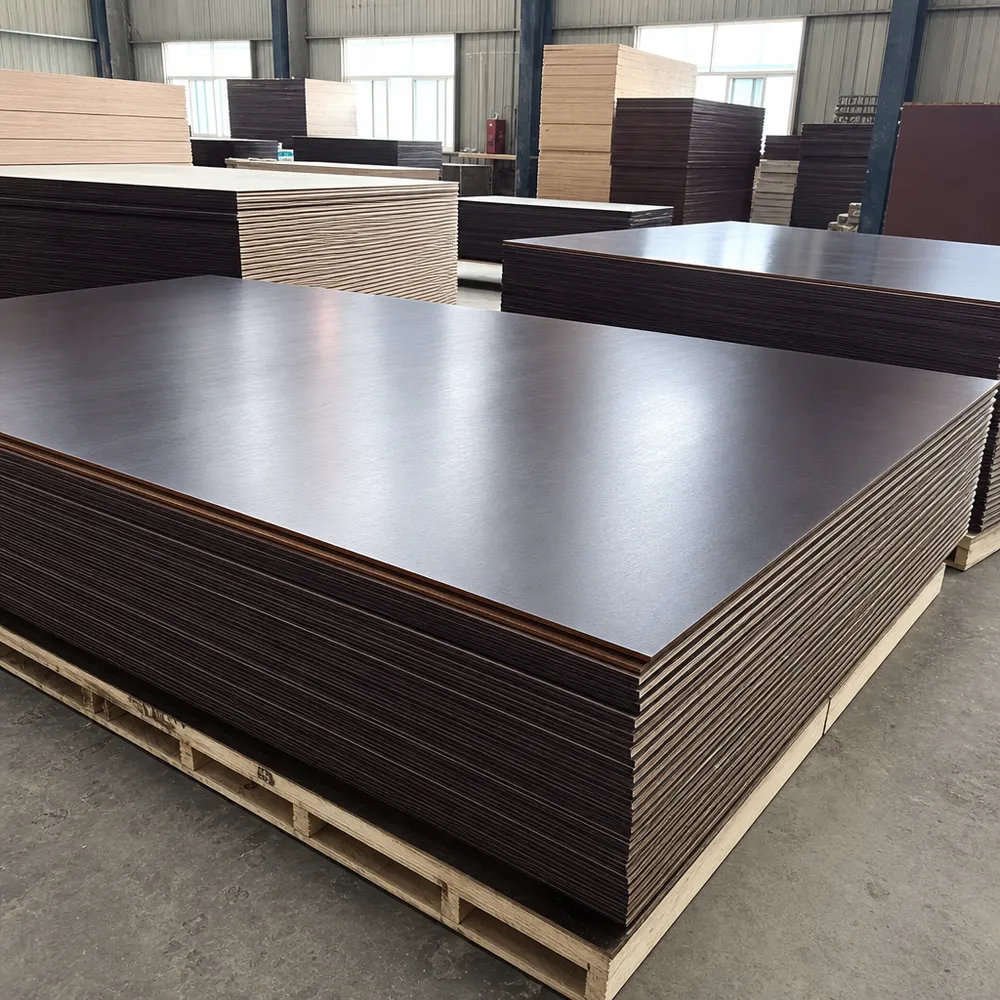
What We Make and Why It Matters for Your Supply Chain
Film faced plywood is the workhorse of concrete formwork — the panel that takes the pour, releases cleanly, and goes back up again.
How the Film Works
The film is what makes reuse possible: a phenolic or melamine resin overlay bonded under heat and pressure to a structural plywood core, creating a surface that resists moisture absorption, concrete adhesion, and mechanical abrasion across multiple pour cycles.
Who We Are
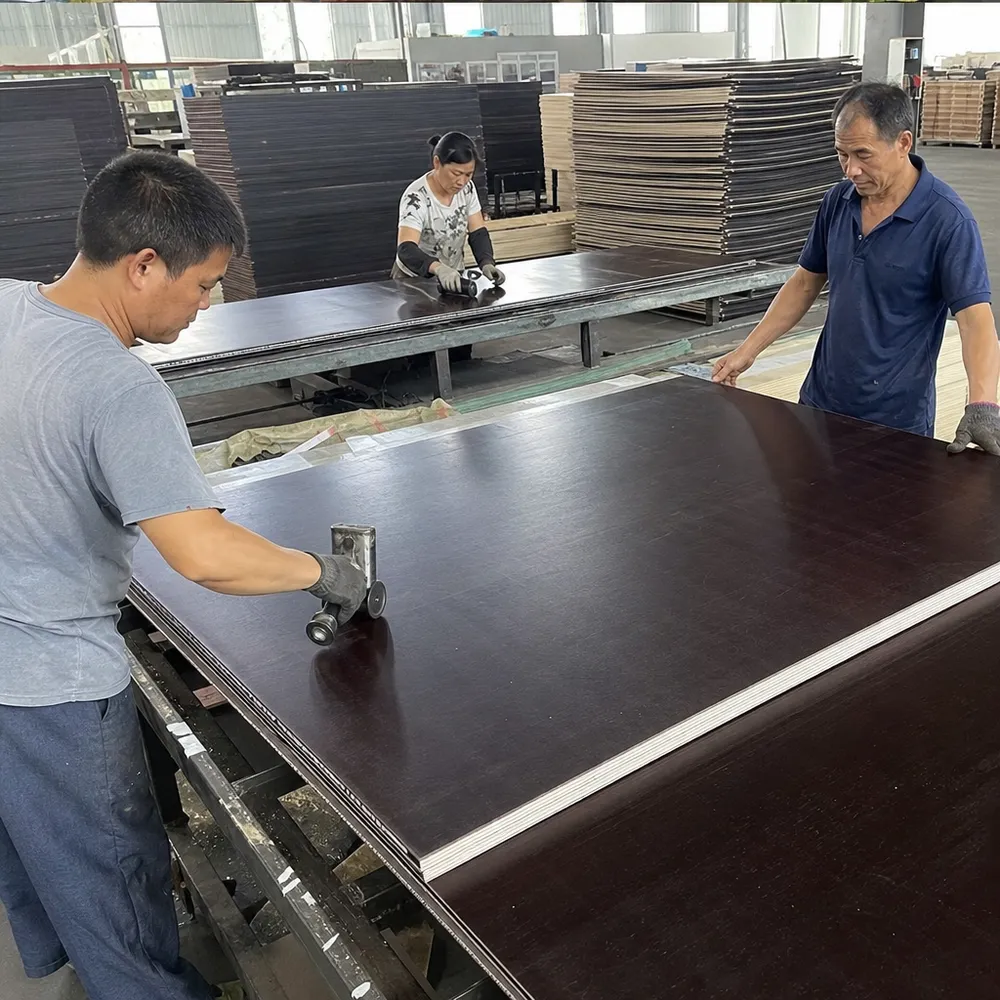
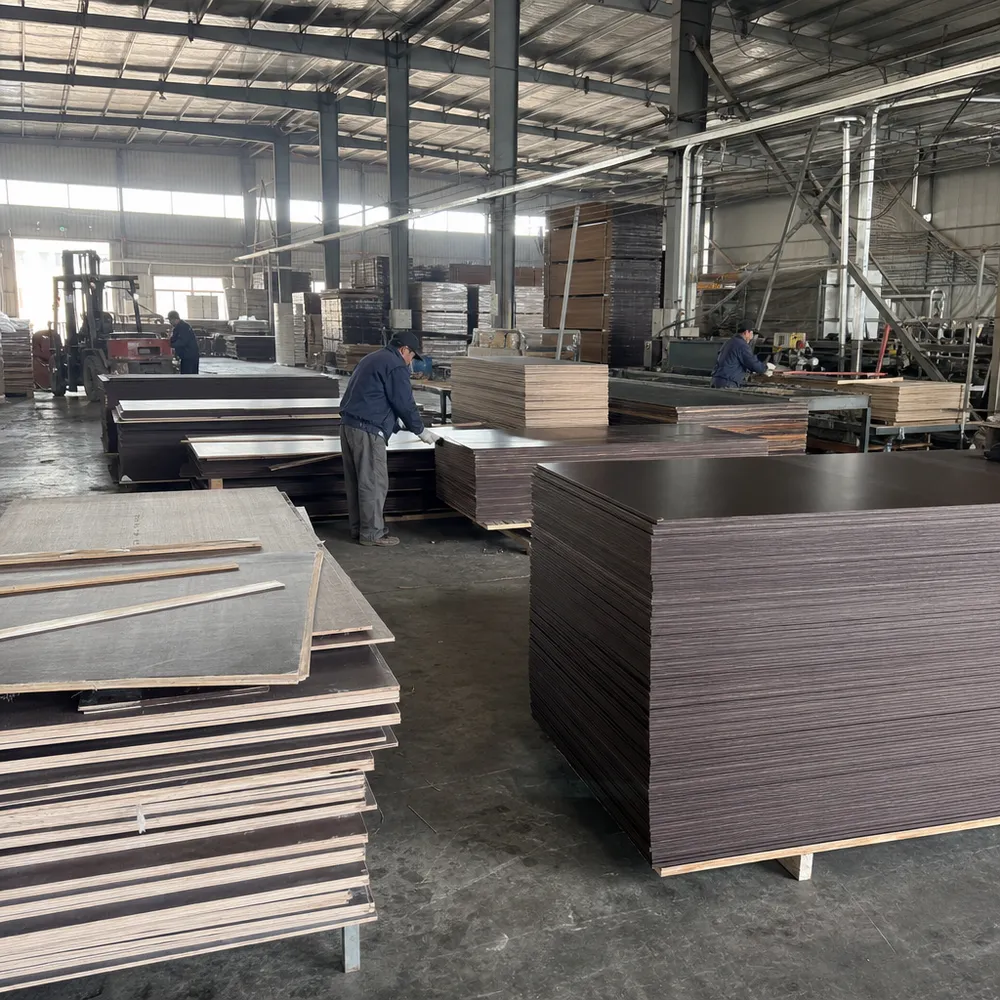
We are Xuzhou QD Wood Industry Co., Ltd., manufacturing film faced plywood and commercial-grade panels since 2008 at our 18,000 m² facility in Sanbao Industrial Park, Xuzhou, Jiangsu Province. Six production lines, 450,000 m³ annual capacity, and a dedicated film overlay lamination line that handles both phenolic and melamine film application in-house.
No trading company layer — your order is priced and shipped directly from the factory that makes it.
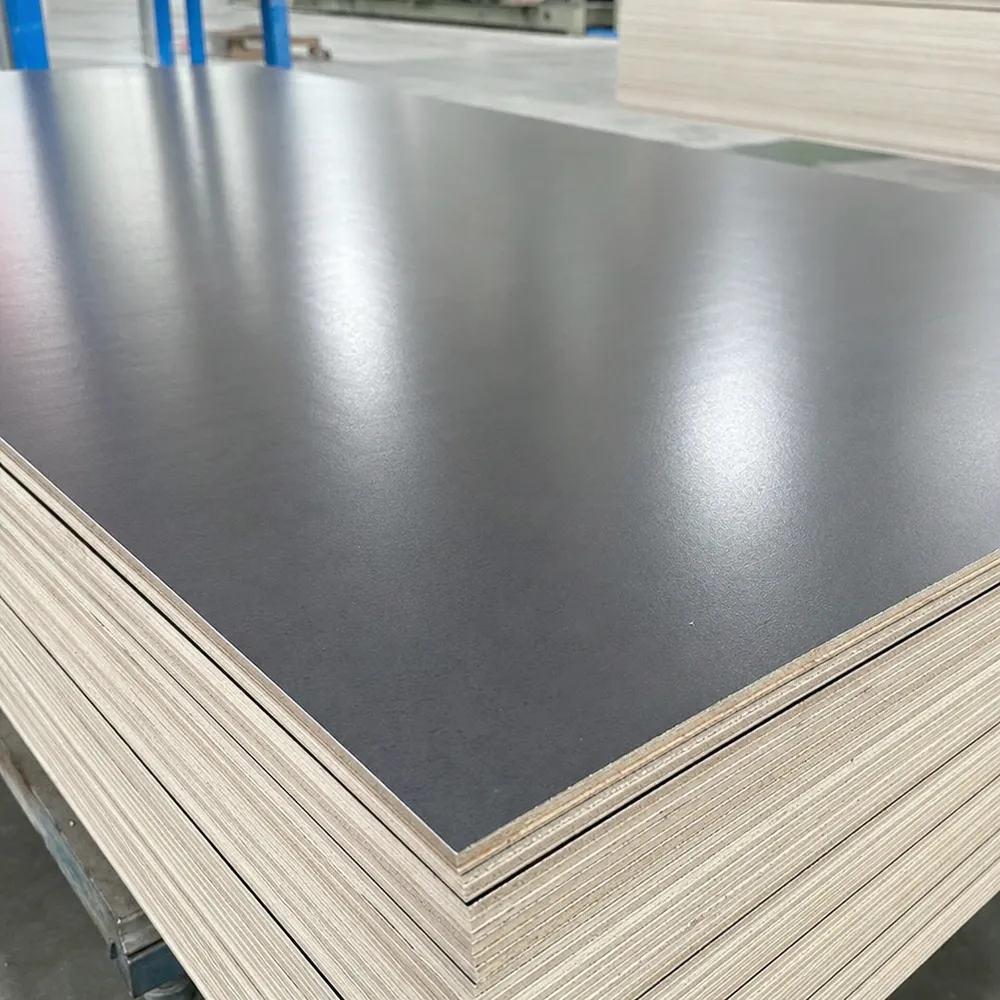
Why Sourcing Quality Matters
The failure modes are expensive. A panel that delaminates mid-pour, warps after two cycles, or leaves surface defects on the concrete face creates rework costs that dwarf the panel price.
The Variables That Determine Reuse Life
Film adhesion, core moisture content, and glue bond quality are what separate a panel that delivers 8–12 reuses from one that fails at three. Here's how we engineer those variables.
Film Adhesion Testing
Cross-cut film adhesion testing on every export batch — not sampled, not spot-checked. Every batch.
Core Moisture Control
Tighter moisture content tolerances in the core prevent the differential expansion that causes warping and delamination under thermal cycling.
Logged Press Parameters
Press temperature, pressure, and dwell time are logged per production run. Traceable process data, not just finished-goods inspection.
In-House Film Lamination
Dedicated film overlay lamination line handles both phenolic and melamine film application in-house — no subcontracted overlay step, no quality handoff gap.
Reuse Performance Benchmark
The process decisions we've made — tighter moisture control, logged press parameters, cross-cut film adhesion testing on every export batch — are what your buyers are actually paying for when they specify film faced plywood by source.
Export Markets
Shipped to buyers across five major regions. Factory-direct pricing, no trading company margin.
Film Faced Plywood Product Line
Nine variants, organized by core construction, film type, and structural application. Each addresses a distinct segment of the formwork and construction market — the right choice depends on your buyers' project environment, reuse requirements, and regional specification standards.
Standard Formwork Variants
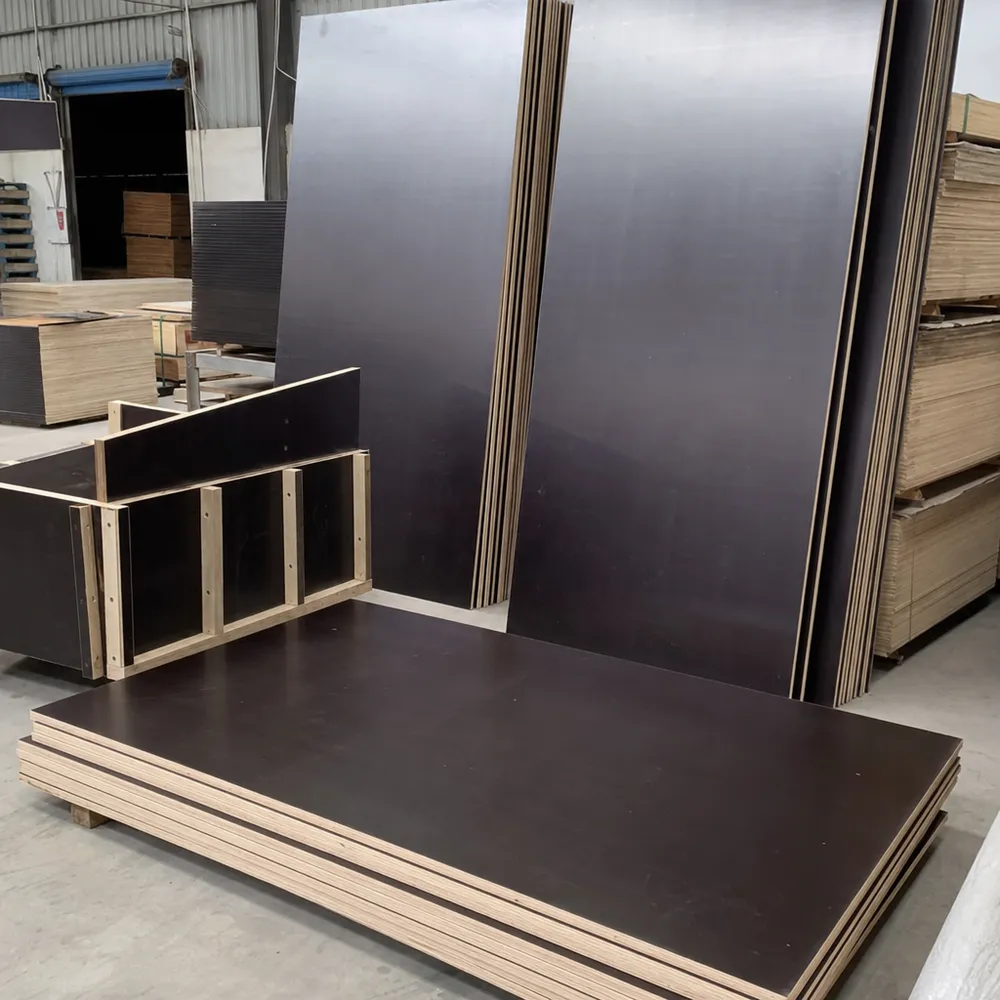
The entry-point thickness for light formwork and wall panel applications. 12mm panels are the volume SKU for residential construction and smaller commercial projects where load requirements are moderate. Your buyers in residential construction and fit-out contracting are the primary market.
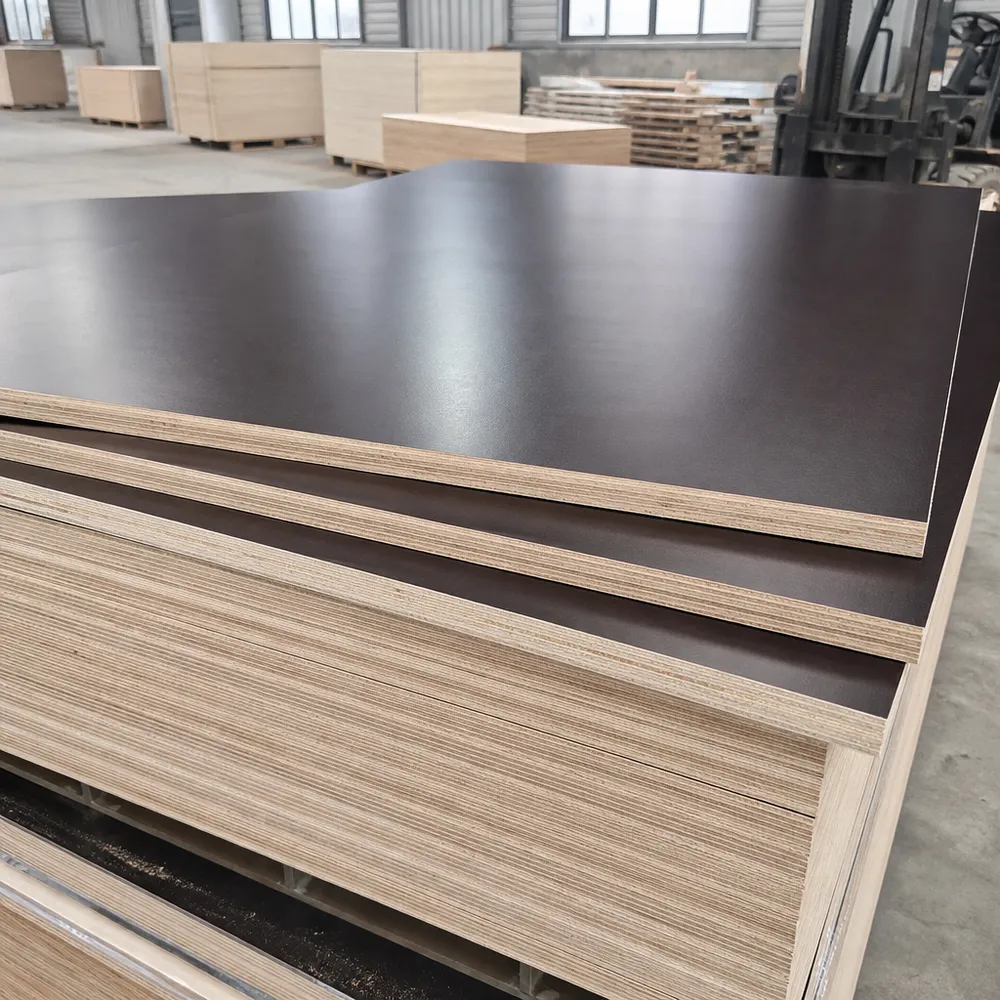
The dominant thickness in commercial and infrastructure formwork globally. 18mm is the specification most structural engineers default to for slab and column formwork — it's the SKU that moves in volume for distributors supplying construction contractors. Available in both standard and custom dimensions.
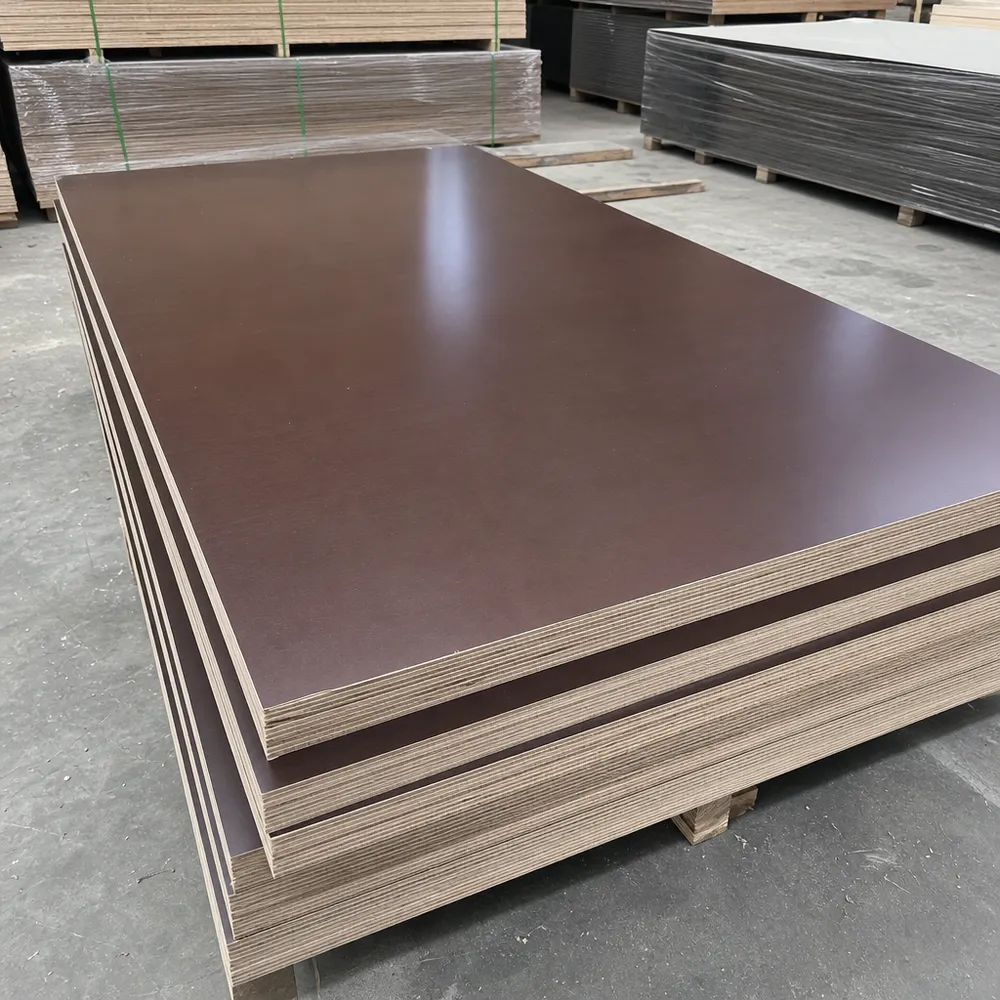
Brown Film Faced Plywood
Brown FilmBrown phenolic film is the standard specification across most Asian and Middle Eastern construction markets. The brown color signals phenolic resin overlay to experienced site buyers — it's a visual shorthand for formwork-grade quality that your buyers recognize immediately. Core construction is poplar or hardwood depending on the order specification.
Shuttering Film Faced Plywood
Shuttering plywood is the UK and Commonwealth market term for concrete formwork panels. Same phenolic film construction, specified to BS and EN standards relevant to those markets. If your buyers are in the UK, Australia, or South Africa, this is the product designation they'll use in their purchase orders — and the certification documentation we provide is formatted accordingly.
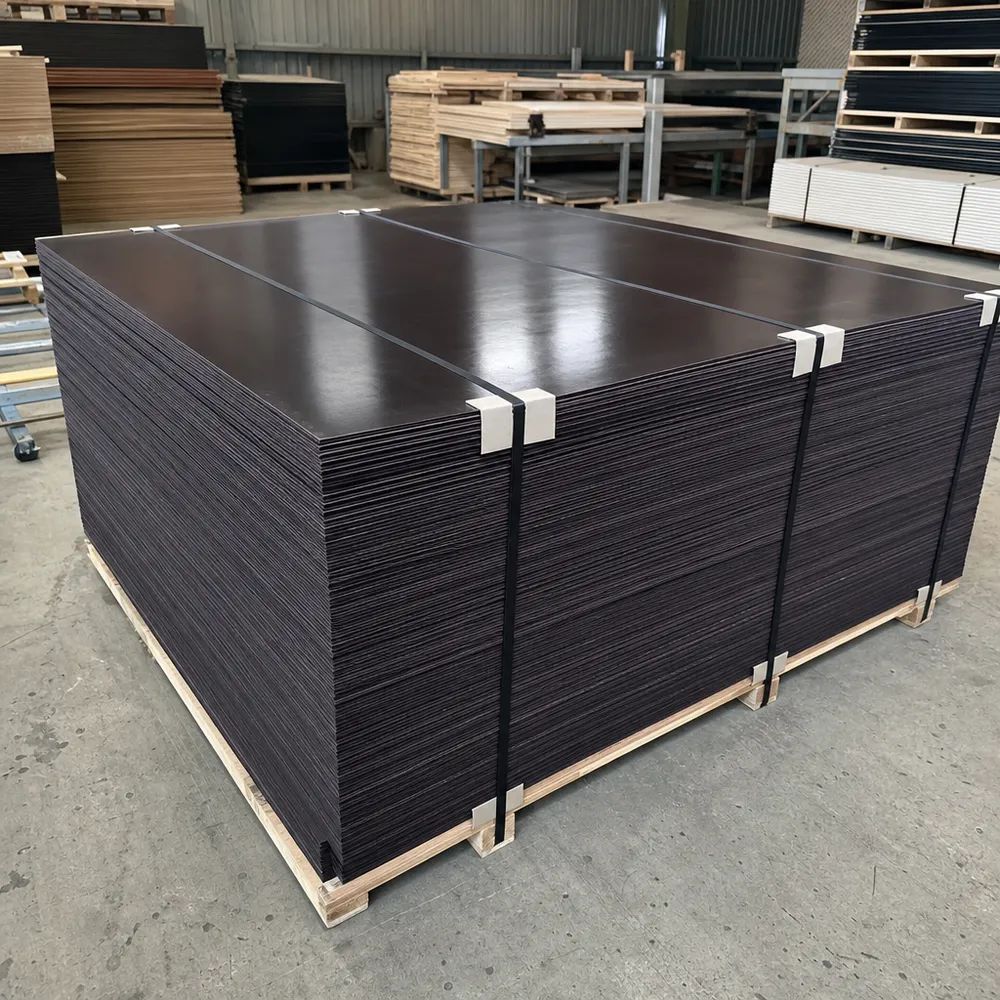
Performance-Upgraded Variants
Higher-specification options for demanding site conditions, aggressive concrete chemistry, or extended reuse requirements.
Phenolic Film Faced Plywood
Performance BenchmarkPhenolic resin film is the performance benchmark for film faced plywood — higher density than melamine film, better resistance to alkaline concrete chemistry, and longer reuse life under repeated wetting and drying cycles.
We run phenolic film at 120–220 g/m² depending on the specification. Film weight is where many suppliers cut corners — lighter film looks identical on the surface but fails adhesion testing after three or four cycles.
We test film adhesion by cross-cut and peel on every export batch — not spot-check, every batch.
Waterproof Film Faced Plywood
High-Humidity & Wet ExposureWaterproof specification combines phenolic film overlay with WBP (Weather and Boil Proof) glue bond throughout the core construction. The WBP bond is the critical variable — it determines whether the panel holds together when repeatedly soaked and dried on a construction site.
Uses MR (moisture resistant) bond for inner plies
WBP bond used throughout — every ply, not just the face
Relevant for buyers supplying projects in high-humidity climates or where panels will be exposed to standing water.
Sourcing note: The distinction between standard MR bond and full WBP bond is not visible on the panel surface. If your project spec or import documentation requires WBP throughout, confirm this explicitly in your purchase order — and ask for the glue bond test report, not just the product name.
Core construction determines density, machinability, fastener retention, and surface finish quality. These variants address buyers with specification requirements that standard poplar-core panels cannot meet.
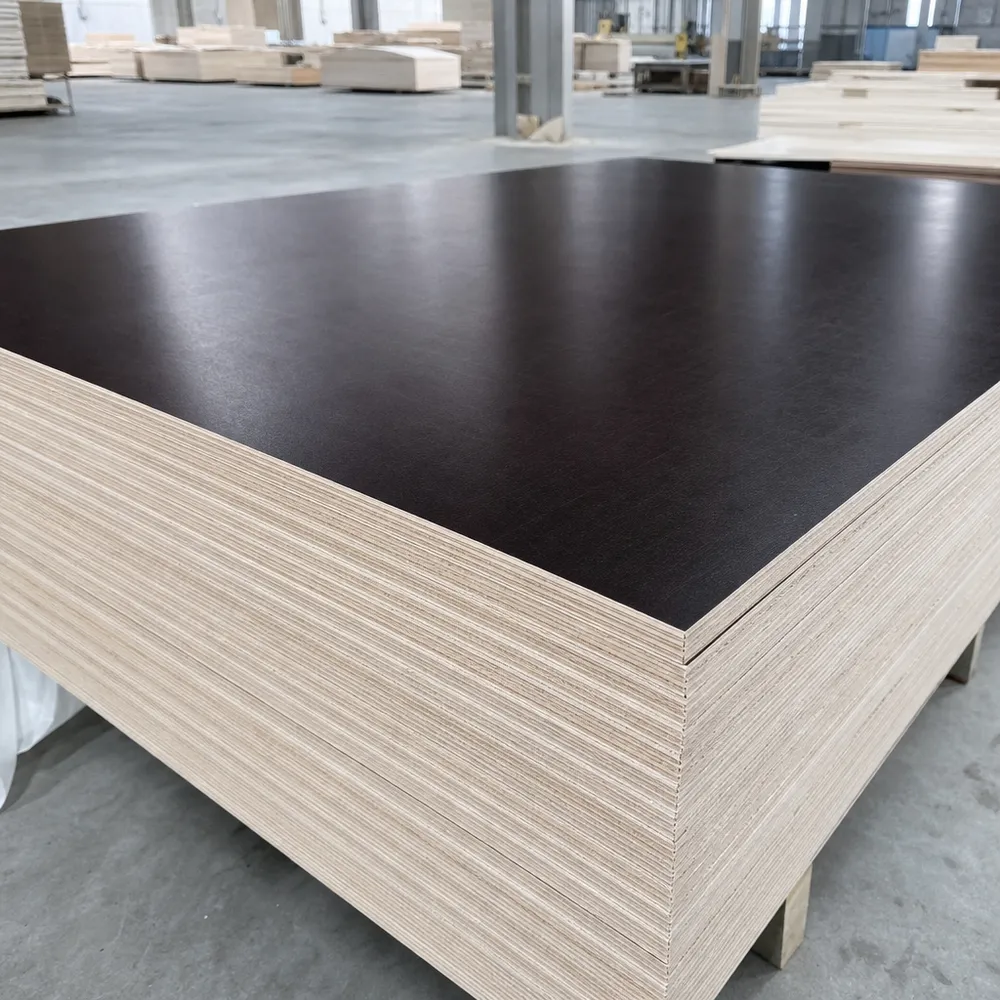
Birch core construction delivers higher density, tighter face grain, and better screw-holding than poplar or mixed hardwood cores. The result is a panel that machines more cleanly, holds fasteners more reliably, and produces a smoother concrete face finish.
Market fit: Buyers supplying European construction markets where birch core is the expected standard for high-quality formwork panels. Sourced from certified suppliers on a dedicated layup sequence to maintain core consistency.
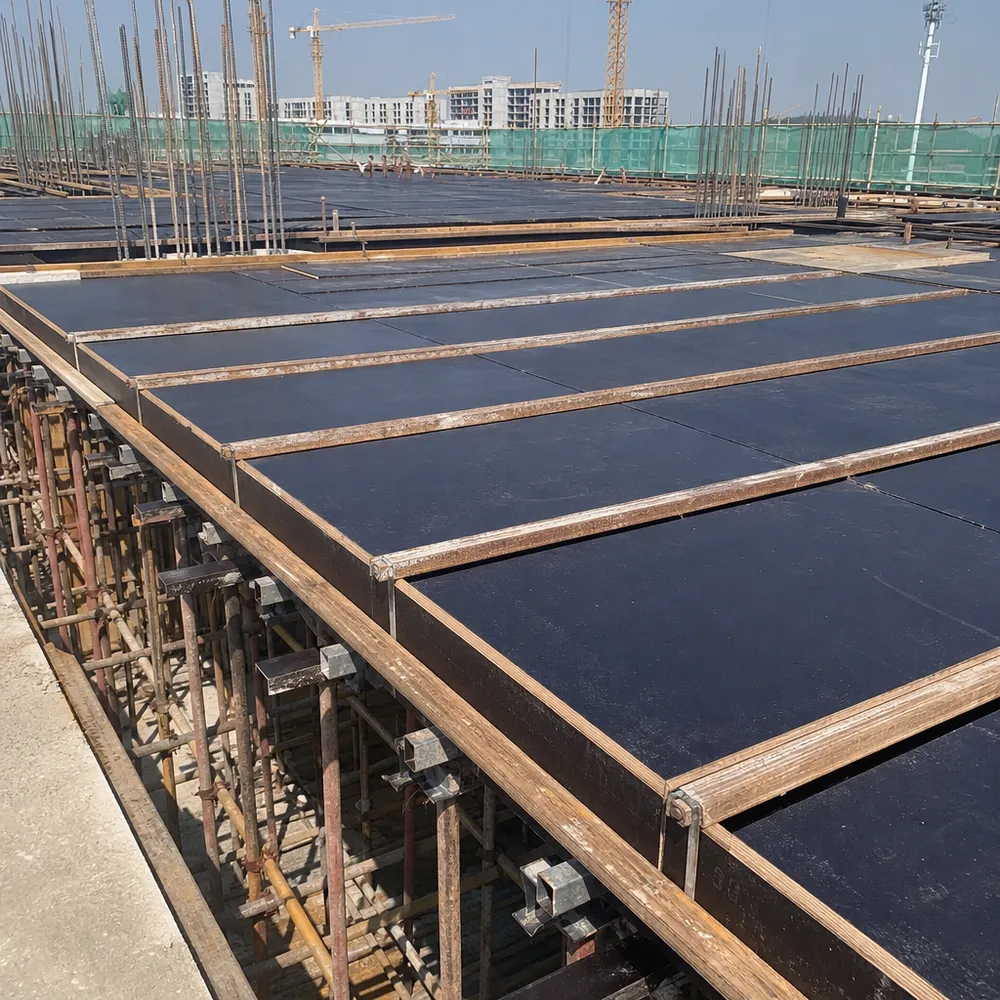
Structural specification means the panel is engineered to defined load-bearing performance — bending strength, modulus of elasticity, and shear strength are tested and documented against EN 13986 or equivalent standards. This is the specification for buyers supplying engineered formwork systems, where the panel is a structural component in a calculated load path, not just a surface form.
Documentation package includes test reports, not just certification claims — required for buyers supplying engineered formwork systems where the panel sits in a calculated load path.
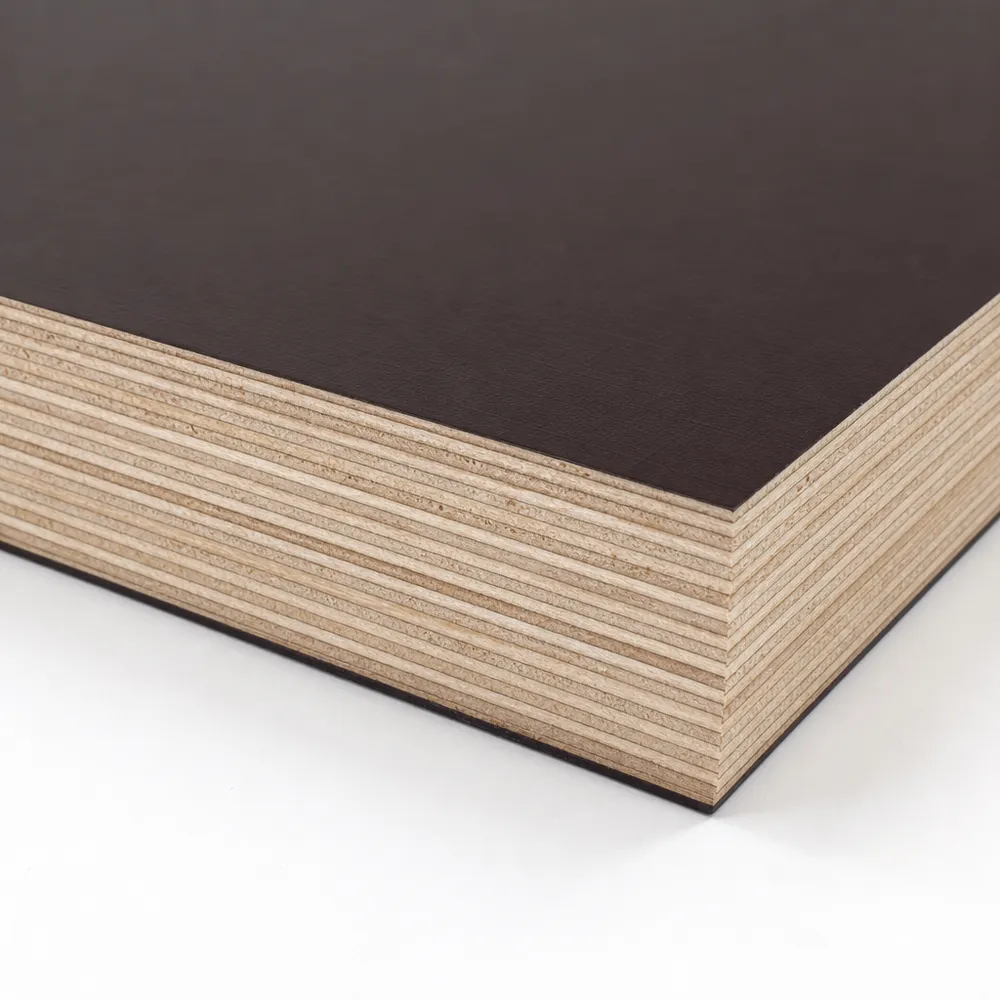
Marine grade adds BS 1088 or equivalent core construction standards to the phenolic film overlay — no core gaps, no voids, full WBP bond throughout. The marine specification is what buyers need when the panel will be used in applications where a core void would create a structural failure point.
Buyer note: A premium SKU with a corresponding price point. For buyers supplying infrastructure contractors, it's the specification that gets specified by name — surface finish quality is critical where a core void would create a structural failure point.
Nine Variants. One Supply Chain.
Every variant in the film faced plywood line is manufactured at the same Xuzhou facility under the same ISO 9001 quality system. Whether you're sourcing standard shuttering panels or marine-grade structural specification, the documentation package, lead times, and container logistics are consistent across the range.
Technical Specifications: What to Expect Across the Range
These are category-wide parameter ranges. Individual product pages carry the exact specifications for each variant.
| Parameter | Range / Options |
|---|---|
| Thickness | 12mm, 15mm, 18mm, 21mm, 25mm (custom available) |
| Panel Size | 1220×2440mm standard; custom dimensions on confirmed orders |
| Film Type | Phenolic resin (120–220 g/m²); Melamine resin |
| Film Color | Brown, black, red (market-dependent) |
| Core Species | Poplar, hardwood, birch (variant-dependent) |
| Glue Bond | WBP (Weather and Boil Proof) throughout |
| Formaldehyde Emission | CARB P2 / E1 / E0 (specification-dependent) |
| Moisture Content | 8–12% (export standard, controlled pre-press) |
| Thickness Tolerance | ±0.2mm (calibrated sanding) |
| Surface Finish | Sanded face; film overlay; edge sealed on export grade |
| Reuse Cycles | 8–12+ (phenolic film, WBP bond, proper site handling) |
| Certifications |
ISO 9001:2015 CE FSC CARB P2
|
Why 8–12% Moisture Matters
Pre-press verification, not post-press testing
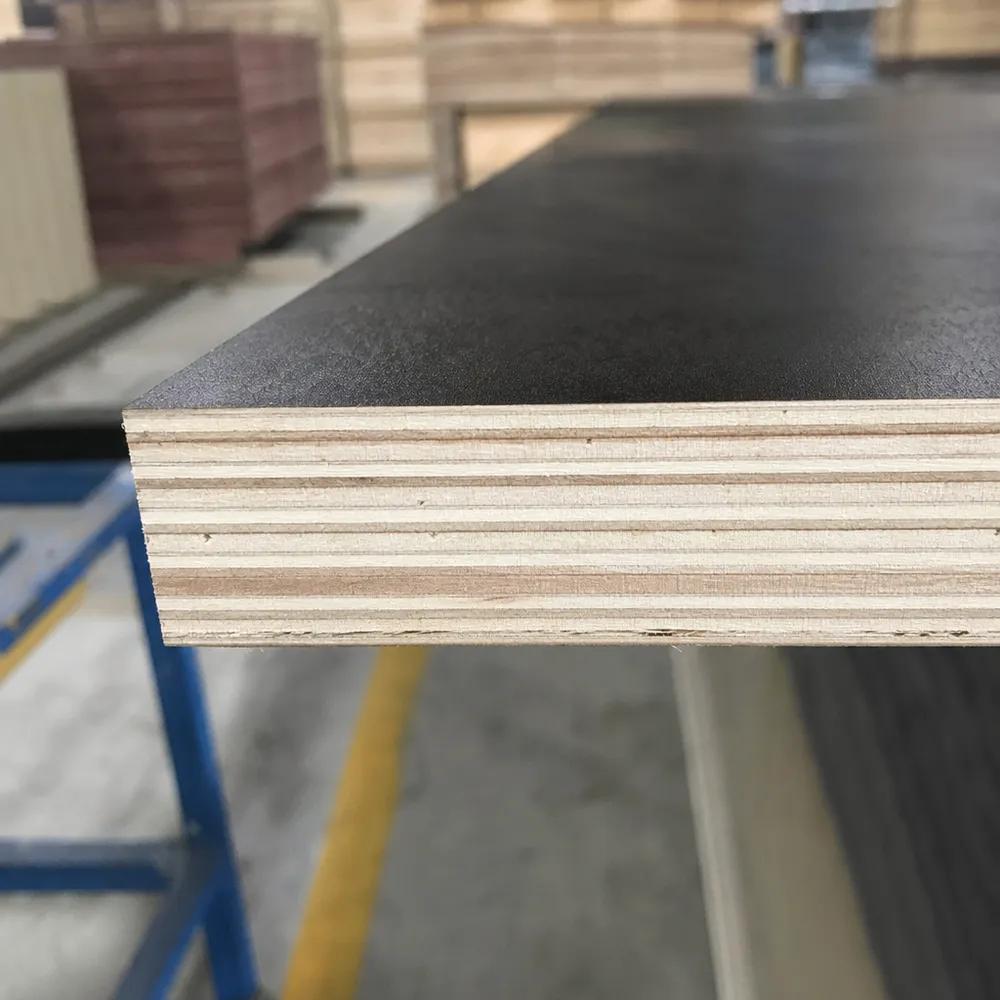
The 8–12% moisture content range is not a target we test for at the end — it's achieved through controlled drying and pre-press moisture verification at the veneer stage.
Panels that enter the press at the wrong moisture content produce thickness variation and dimensional instability after pressing, regardless of how well the press parameters are set. We check veneer moisture before layup, not after the panel is already made.
View exact specifications by variant
How Film Adhesion Determines Reuse Life — and Where Failures Come From
This is the section most category pages skip, which is exactly why it's worth covering. Film faced plywood fails in the field in three ways: film delamination, core delamination, and edge failure. Each has a different root cause, and each is preventable with the right manufacturing decisions.
Failure Mode 01
Film Delamination
What it looks like
The film lifts from the face veneer after a few pour cycles.
Root cause
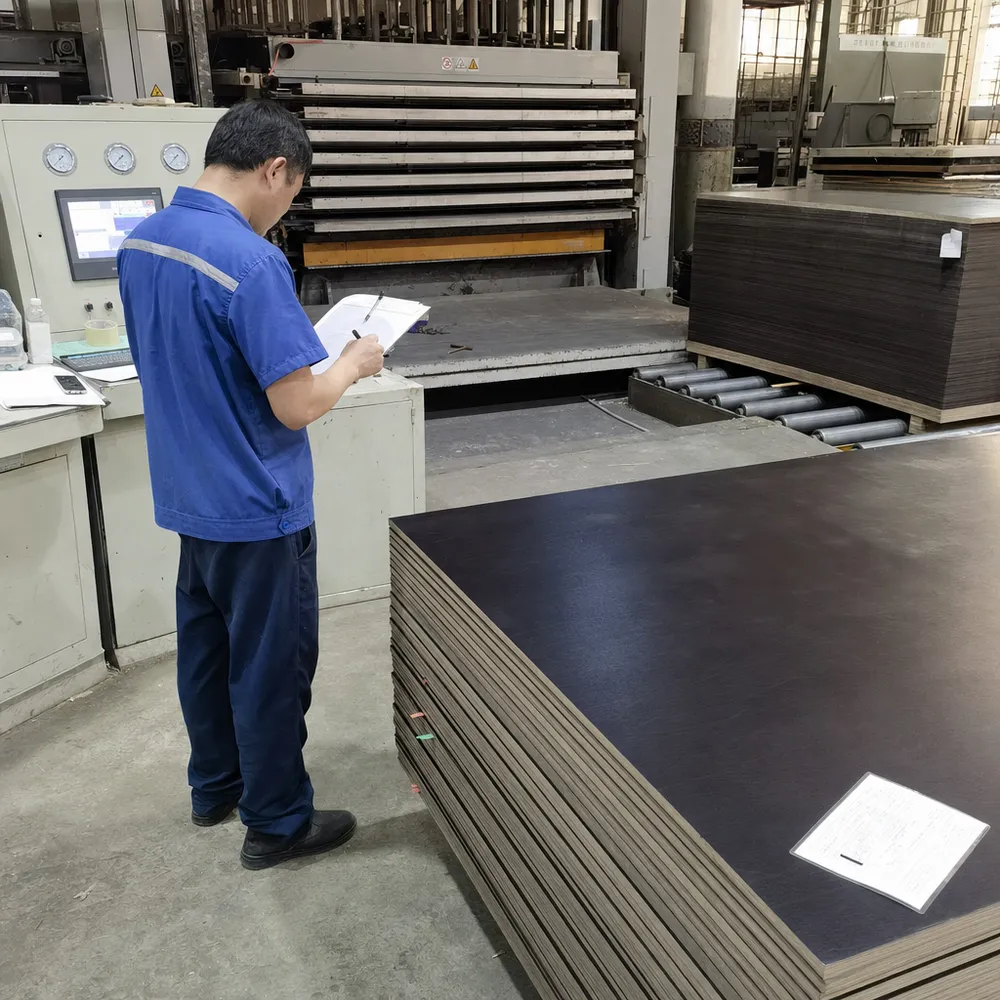
Almost always a press parameter problem. The phenolic film bonds to the face veneer through a combination of heat, pressure, and dwell time. If press temperature is uneven across the panel surface, or if dwell time is cut short to increase throughput, the bond is incomplete in the low-pressure zones. The panel looks fine on inspection but fails under repeated wetting.
How we prevent it
We log press parameters per batch — temperature, pressure, and dwell time — so if a film adhesion issue surfaces, we can trace it to the specific production run and identify whether it was a process deviation or a material issue.
Failure Mode 02
Core Delamination
What it looks like
Inner plies separating under load or moisture cycling.
Root cause
Two sources: inadequate glue spread on inner plies, or veneer moisture content that was too high at layup. Both are process discipline issues.
How we prevent it
We run automated glue spreading with weight checks against specification, and we verify core veneer moisture before layup. The temptation in high-volume production is to skip the pre-press moisture check when the schedule is tight — we don't, because the downstream cost of a delamination claim is not worth the throughput gain.
Failure Mode 03
Edge Failure
What it looks like
Panel edges absorb moisture and swell, causing the film to lift at the perimeter.
Root cause
A packaging and handling issue as much as a manufacturing issue. Edge sealing only works if the panel arrives at the job site with the seal intact.
How we prevent it
We apply edge sealing on export-grade panels and pack them in moisture-resistant film for ocean transit. We include handling notes in the documentation package for buyers who are supplying contractors unfamiliar with film faced plywood storage requirements.
Why This Matters for Your Buyers
Understanding these failure modes is what lets you have a credible conversation with your buyers about why specification and source matter — and why the cheapest panel on the market is rarely the cheapest panel on the job site.
Batch-level press logs enable root-cause tracing if a film adhesion issue surfaces post-delivery
Automated glue spread with weight verification eliminates the most common source of core delamination claims
Edge sealing plus moisture-resistant ocean packing protects the panel through the full transit chain, not just the factory gate
Handling documentation included for buyers supplying contractors unfamiliar with proper film faced plywood storage
Market Segments Where Film Faced Plywood Moves in Volume
Film faced plywood is a construction consumable — it gets used, reused, and eventually replaced. That cycle is what makes it a reliable recurring revenue category for distributors and construction supply companies.
Infrastructure & Civil Construction
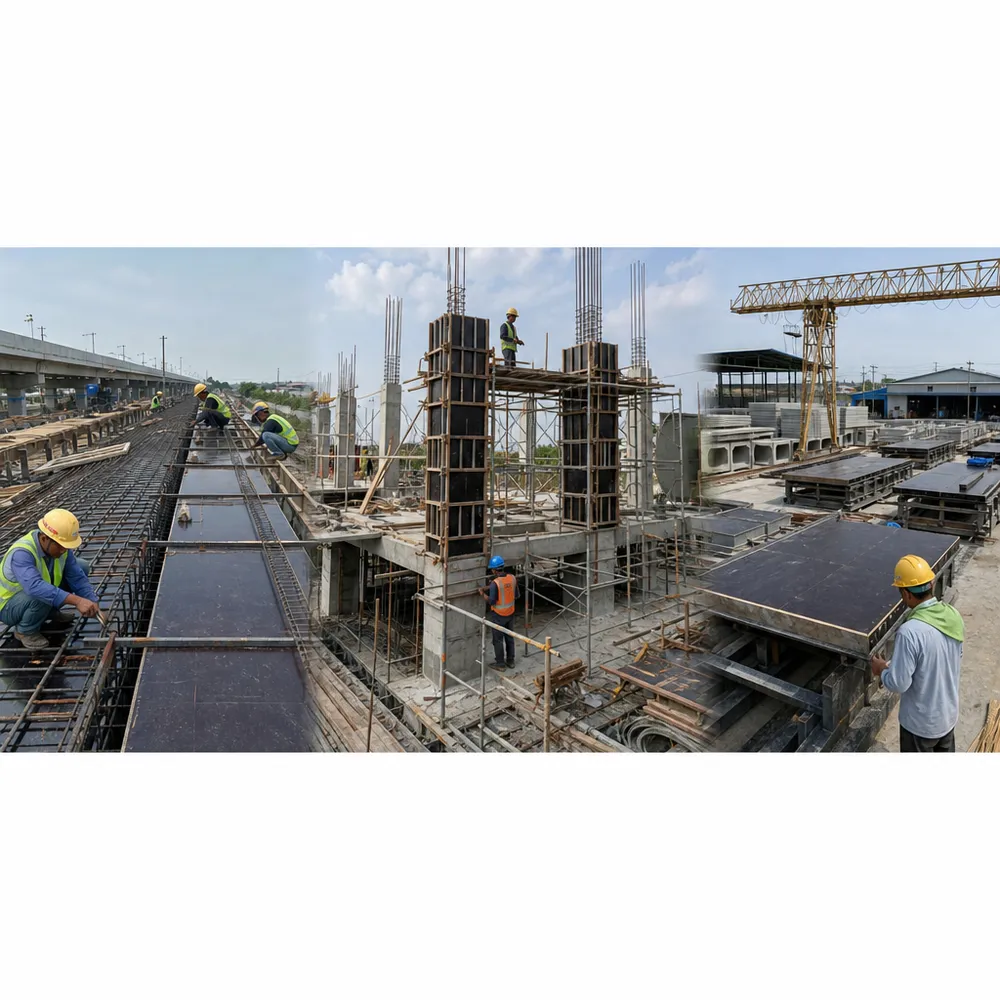
Highest Global VolumeBridge decking formwork, tunnel lining, retaining wall construction. These projects specify phenolic film, WBP bond, and often structural-grade documentation. Order sizes are large, specifications are tight, and buyers in this segment are experienced enough to know what they're asking for.
Relevant SKUs
Commercial Building Construction
Volume Market for 18mmHigh-rise residential, office towers, mixed-use developments. Contractors buy in container quantities, reuse panels across multiple floor cycles, and replace them on a project-by-project basis. Consistent batch quality matters most here — a contractor who gets one container that performs differently from the last will switch suppliers.
Relevant SKUs
Residential & Light Commercial
Consistent DemandThe market for 12mm panels and standard brown film faced plywood. Higher buyer fragmentation, smaller order sizes, but consistent demand. Distributors supplying building merchants and hardware chains are the channel here.
Relevant SKUs
Prefabricated Concrete & Precast Manufacturing
B2B-to-B2B ChannelFactories producing precast wall panels, stairs, and structural elements use film faced plywood as the form surface. Your buyer is a precast manufacturer, not a construction contractor. Reuse cycles are higher (controlled factory environment vs. outdoor construction site), and surface finish quality is more critical because the concrete face is the finished product.
Engineered Formwork System Manufacturers
OEM / Custom SpecCompanies that design and sell proprietary formwork systems — frame systems, climbing formwork, table forms — use film faced plywood as the panel component. These buyers specify to tight tolerances and often require OEM marking or custom dimensions. Our OEM capability covers custom panel sizes, custom film colors, and branded edge marking.
Capability
Selecting the Right Variant: A Sourcing Decision Framework
The nine variants in our range address different combinations of core quality, film performance, and market specification. Here's how to match them to your buyers' requirements.
European Markets
Birch Core RequiredEuropean construction specifications and buyer expectations default to birch core film faced plywood. Poplar core panels are perceived as lower quality regardless of film specification.
Recommended starting point: Birch core, any film specification.
Birch Film FacedMiddle East & Southeast Asian Markets
Brown 18mm StandardBrown phenolic film faced plywood in 18mm is the standard specification. The brown color is the market signal for formwork-grade quality in these regions.
Infrastructure & Civil Engineering Projects
Documentation CriticalStructural documentation matters as much as the panel itself. Both Structural and Marine variants come with test reports, not just certification claims. Specify Marine if the application requires marine-grade core construction.
Recommended starting point: Structural or Marine depending on core requirement.
High-Humidity Climates
WBP Bond Non-NegotiableGulf states, coastal Southeast Asia, tropical markets. WBP bond throughout the core is non-negotiable. Engineered specifically for repeated wetting and drying cycles without core delamination.
Recommended starting point: Waterproof Film Faced Plywood.
WaterproofUK, Australia & Commonwealth Markets
Shuttering Designation"Shuttering plywood" is the product designation buyers in these markets will use. Documentation is formatted to match the standards those markets expect.
Recommended starting point: Shuttering Film Faced Plywood.
ShutteringBuilding a Starter SKU Mix for a New Market
Universal Entry Point18mm brown phenolic film faced plywood is the universal entry point — it moves in every construction market, it's the specification most buyers default to, and it gives you a baseline to expand from once you understand your buyers' specific requirements. Most of our new distributor relationships start with a trial container of 18mm before expanding into the full range.
Recommended starting point: Trial container of 18mm brown phenolic.
18mm| Your Buyer's Market | Key Requirement | Recommended Variant |
|---|---|---|
| Europe | Birch core specification | Birch Film Faced Plywood |
| Middle East / SE Asia | Brown phenolic, 18mm standard | Brown / 18mm Film Faced Plywood |
| Infrastructure / Civil | Structural documentation + test reports | Structural / Marine Film Faced Plywood |
| High-Humidity / Tropical | WBP bond, delamination resistance | Waterproof Film Faced Plywood |
| UK / Australia / Commonwealth | Shuttering designation, local standards | Shuttering Film Faced Plywood |
| New Market Entry | Universal SKU, broadest demand | 18mm Brown Phenolic Film Faced Plywood |
Thickness Selection
Which Thickness Is Right for Your Application?
Thickness drives load capacity, reuse count, and freight cost per panel. The right choice depends on your buyers' pour depth, shoring system, and how many cycles they expect from each panel.
Slab formwork with close joist spacing, lightweight concrete pours, and applications where panel weight is a handling constraint. Lower reuse count than 18mm.
12mm Film Faced PlywoodA step up in stiffness from 12mm without the weight penalty of 18mm. Used in wall and column formwork where intermediate support spacing allows it.
15mm Film Faced PlywoodThe global standard for concrete formwork. Balances stiffness, reuse count, and freight efficiency better than any other thickness. Default specification across Middle East, SE Asia, and most export markets.
18mm Film Faced PlywoodDeeper pours, wider support spacing, and high-cycle formwork systems where deflection control is critical. Specified when 18mm doesn't meet the structural engineer's deflection limits.
21mm Film Faced PlywoodInfrastructure and civil engineering applications with extreme load requirements. Retaining walls, bridge decking formwork, and large-scale pours where maximum rigidity is non-negotiable.
25mm Film Faced PlywoodNot Sure Which Thickness?
Tell us your buyers' application — pour depth, support spacing, and expected reuse count — and we'll confirm the right specification before you commit to a container.
Film Color
Brown vs Black vs Red: What the Color Actually Signals
Film color is not cosmetic. In most markets it's a shorthand for grade, resin type, and intended application. Buyers use color as a quick specification filter before they read the data sheet.
Brown Film
- Standard phenolic resin film
- Default specification in Middle East, SE Asia, Africa
- 120–220 g/m² film weight range
- Broadest market acceptance globally
Black Film
- Higher resin density phenolic film
- Preferred in European and premium export markets
- Superior surface hardness and abrasion resistance
- Higher reuse count in demanding formwork systems
Red Film
- Melamine-phenolic or high-density phenolic film
- Smooth concrete finish surface quality
- Architectural concrete and fair-faced applications
- Specified where concrete surface appearance matters
Color-to-Market Quick Reference
Brown → Middle East, SE Asia, Africa
Standard phenolic, widest acceptance, 18mm default
Black → Europe, Premium Projects
Higher density film, extended reuse, premium specification
Red → Architectural Concrete
Fair-faced finish quality, smooth surface, appearance-critical pours
FAQ
Questions Buyers Ask Before Their First Order
Answers to the specification and sourcing questions that come up most often from importers, distributors, and procurement teams.
Regular plywood has no surface treatment and is not designed for contact with wet concrete. Film faced plywood has a phenolic resin film bonded to both faces under heat and pressure, creating a hard, waterproof surface that releases cleanly from cured concrete.
The film also protects the core veneers from moisture penetration during repeated wetting cycles, which is what allows the panel to be reused 8–20+ times depending on specification and site handling. Standard plywood would delaminate and swell after the first pour.
Reuse count depends on film weight, core quality, and site handling. As a practical guide: standard brown phenolic (120 g/m² film) delivers 8–12 reuses under normal site conditions. Higher film weight panels (220 g/m²) and black phenolic variants reach 15–20+ reuses in well-managed formwork systems.
The biggest variable is site handling — panels that are cut cleanly, stored flat, and not dragged across abrasive surfaces will significantly outlast panels on poorly managed sites regardless of specification.
At minimum: a mill test report confirming film weight, core species, glue bond class (WBP/Exterior), and panel dimensions. For European markets, CE marking under EN 13986 is increasingly required for structural applications. For infrastructure projects, ask for third-party test reports rather than self-certified documentation.
CARB Phase 2 compliance documentation is required for any product entering the US market. FSC certification is relevant if your buyers have sustainability procurement requirements. We provide full documentation packages with every shipment — ask us to confirm what's included for your destination market.
A standard 20ft container holds approximately 400–440 sheets of 18mm film faced plywood in 1220×2440mm (4×8ft) format, depending on exact panel weight and loading configuration. A 40ft container holds approximately 800–880 sheets.
Panel weight for 18mm is typically 28–32 kg per sheet depending on core species and moisture content at time of loading. We provide exact packing lists and weight declarations with each shipment for customs and freight planning purposes.
Yes. The waterproof film surface and WBP core bond make it suitable for truck and trailer flooring, container flooring, site hoarding, scaffold decking, and any application requiring a durable, moisture-resistant panel.
For flooring applications, anti-slip film variants (mesh-embossed surface) are available and preferred where slip resistance is a safety requirement. The core construction is identical — only the surface film texture differs.
Our standard minimum order is one 20ft container. For new distributor relationships, we recommend starting with a single container of 18mm brown phenolic to validate quality and market fit before scaling to larger volumes.
Mixed-specification containers (multiple thicknesses or variants in one container) are available for buyers who need to test multiple SKUs simultaneously. Contact us to discuss the logistics and minimum quantities per line item for mixed loads.
Certifications and What They Mean for Your Import Documentation
Our certification stack covers your key import markets without requiring you to qualify a separate supplier for each region. One factory, one audit relationship, one documentation package that works for North America, Europe, and the markets in between.
Quality Management
Quality management system certification covering our production processes, QC procedures, and documentation controls. Relevant for buyers whose procurement policies require certified suppliers.
Scope: Production · QC · Documentation
European Market
Conformity marking for the European market, covering construction product performance requirements under EN 13986 (wood-based panels for use in construction). Required for film faced plywood sold into EU construction projects.
Included: CE declaration of conformity with EU-bound shipments as standard
Sustainability
The wood fiber in our panels can be traced to FSC-certified forests. Relevant if your buyers have sustainability sourcing policies, or if you're supplying into markets where deforestation-linked supply chains create reputational or regulatory risk.
Available on request for certified orders
Most Stringent Standard
California Air Resources Board Phase 2 formaldehyde emission standard — the most stringent in our export markets. We formulate to CARB P2 as the baseline across our product range, not as a special option.
US-bound shipments: CARB documentation package prepared as standard
One Factory. One Audit. Every Market.
Our certification stack covers your key import markets without requiring you to qualify a separate supplier for each region. One factory, one audit relationship, one documentation package that works for North America, Europe, and the markets in between.
OEM and Custom Specification Capability
Film faced plywood is a product category where custom specification is common — construction companies specify panel dimensions to match their formwork system geometry, and engineered formwork manufacturers require panels built to their proprietary tolerances.
Lead Time from Specification
From specification confirmation to first production sample, depending on material sourcing requirements.
Custom Panel Dimensions
Non-standard sizes cut to your specification on confirmed orders. No tooling cost — plywood is cut-to-size, not molded.
Custom Film Color
Brown, black, and red are the standard market colors. Custom colors are available on runs that justify the film sourcing lead time.
Custom Film Weight
Standard phenolic film runs at 120–220 g/m². Higher film weights for extended reuse applications are available on specification.
Custom Core Construction
Birch, hardwood, or poplar core; specific ply count and thickness combinations for defined structural performance.
OEM Branding
Edge marking, panel stamping, and custom packaging for buyers who sell under their own brand.
Custom Formaldehyde Specification
E0, E1, or CARB P2 — we can produce to the emission standard your market requires.
How OEM Orders Work
Send Target Specification + Destination Market
Share your panel dimensions, film type, core preference, emission standard, and the market you're supplying into.
Receive Detailed Proposal + Certification Documentation
We come back with a detailed proposal and the relevant certification documentation for your target market.
Specification Confirmation
Once specification is confirmed, production sample lead time runs 15–20 working days depending on material sourcing requirements.
Sample Approval → Production Run
Sample approval triggers the full production run with your OEM branding, packaging, and documentation package.
Entering a New Market or Building a Private-Label Line?
Send us your target specification and destination market — we'll come back with a detailed proposal and the relevant certification documentation.
Container Loading and Transit Reality
Film faced plywood ships efficiently in standard containers. Here's what to expect from loading configuration through port arrival.
Container Loading Configuration
Standard 1220×2440mm panels, flat-stacked
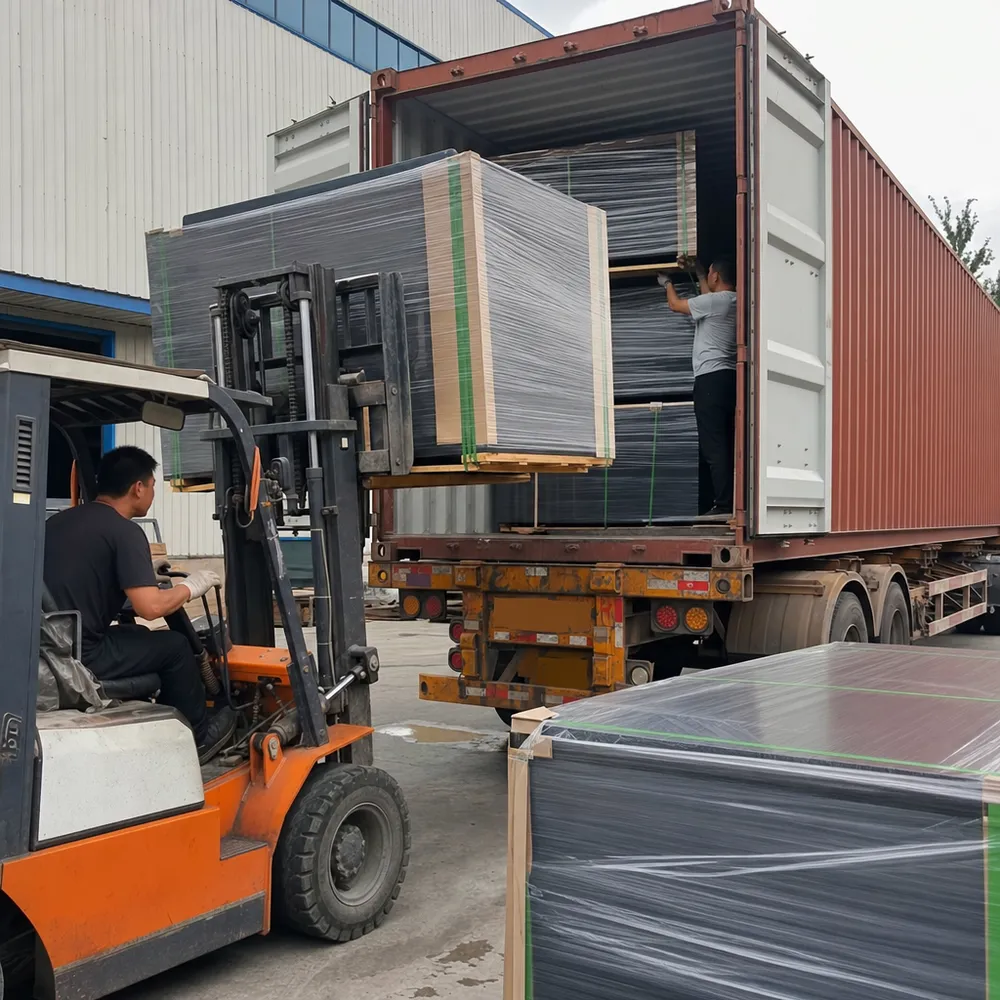
Standard 1220×2440mm panels stack flat and load without wasted space. A 40HQ container typically holds 20–22 m³ of panels depending on thickness and stacking configuration.
We provide loading plans with each shipment so your receiving team knows the exact bundle count and stacking arrangement before the container arrives.
Export Packaging
Protection from factory to job site
- Panels bundled and strapped with edge-protection corner boards
- Wrapped in moisture-resistant film
- Each bundle marked: specification, thickness, quantity, batch number, destination port
- Additional moisture barrier packaging available on request for humid-climate destinations
The film surface protects the face, but panel edges and core are vulnerable to moisture ingress during extended ocean transit if not properly wrapped. Specify additional moisture barrier packaging for humid-climate destinations.
Transit Times from Xuzhou
Xuzhou connects to Qingdao, Shanghai, and Lianyungang. We route based on schedule and freight cost for your destination.
Rotterdam, Hamburg, Felixstowe
Major East Coast ports
Major West Coast ports
Jebel Ali, Dammam
Regional ports
Export Documentation
For mixed-product containers, we coordinate consolidated loads and provide a single documentation package covering all line items.
Sourcing Questions, Answered Directly
Common questions from importers, distributors, and procurement teams evaluating film faced plywood supply.
Phenolic film is a thermosetting resin overlay — denser, harder, and more resistant to the alkaline chemistry of wet concrete than melamine film. It handles more reuse cycles and performs better in outdoor and high-moisture environments.
Melamine film is a lower-cost option suitable for interior applications and lighter-duty formwork where the alkaline exposure is limited.
Specify Phenolic When:
Standard concrete formwork, outdoor or high-moisture environments, higher reuse cycle requirements.
Melamine Is Viable When:
Interior shuttering, cost is the primary driver, low reuse cycles expected, limited alkaline exposure.
Most of our export volume is phenolic film.
With phenolic film, WBP bond, and proper site handling — including cleaning the face after each pour and storing panels flat and covered — 8–12 reuse cycles is a realistic expectation.
The variables that reduce reuse life are:
- Mechanical damage from improper stripping — prying against the film face rather than the edge
- Inadequate cleaning between pours
- Storage in direct sunlight or standing water
Panels that are stripped carefully and stored correctly consistently outperform panels that are handled roughly, regardless of specification.
18mm
Standard specification for most residential and commercial applications. Carries the weight of wet concrete plus construction loads.
12–15mm
Often sufficient for standard pour heights. Specify 18mm for taller pours or higher-pressure applications.
The structural engineer on the project should confirm the specification. If your buyers are asking for a default recommendation, 18mm covers both applications and is the SKU that moves in volume.
Formaldehyde emission standard required for wood products sold in California and increasingly adopted as the de facto national standard by US importers. We prepare the CARB documentation package as standard for US-bound shipments.
Chain-of-custody documentation required by buyers with sustainability sourcing policies.
No mandatory structural certification at the federal level, but buyers supplying engineered formwork systems may require test reports to EN or ASTM standards.
MOQ varies by variant and specification:
18mm brown phenolic, 12mm standard — available from one container load.
Custom dimensions, custom film colors, and OEM-branded panels require confirmed orders of sufficient volume to justify the production run. Contact us with your specification to confirm MOQ and lead time.
For buyers evaluating a new product line, we can arrange sample panels before committing to a container order.
Store flat on a level surface
Stack panels horizontally on bearers spaced no more than 400mm apart. Uneven support allows panels to sag and take a permanent set.
Keep covered and off the ground
Cover stacks with a tarpaulin or sheeting to prevent differential moisture absorption between the top and bottom faces, which is the primary driver of warping.
Avoid direct sunlight on one face
Prolonged UV exposure on a single face creates a moisture and temperature gradient across the panel thickness, accelerating bow.
Seal cut edges on site
If panels are cut to size, apply edge sealant to the exposed core. Moisture ingress through unsealed edges is the fastest route to delamination and warp.
Panels that arrive flat and are stored correctly will perform flat. Warping that appears after delivery is almost always a site handling issue, not a manufacturing defect.
Get a Quote on Film Faced Plywood
Tell us your specification — thickness, film color, volume, and destination port — and we'll respond with pricing, lead time, and documentation within one business day.
No commitment required. Sample panels available for qualified buyers.
Start Your Film Faced Plywood Sourcing
We export film faced plywood to North America, Europe, the Middle East, Southeast Asia, and Australia. Factory-direct pricing, full certification documentation, and 18 years of export-grade production behind every container.
What to Include in Your Quote Request
Send us your target specification and we'll come back with a detailed quote and the relevant certification documentation for your import requirements.
-
Thickness — e.g. 12mm, 15mm, 18mm, or custom
-
Film Type — phenolic or melamine, film weight (120–220 g/m²)
-
Core Species — eucalyptus, poplar, birch, or combi
-
Panel Dimensions — standard 1220×2440mm or custom cut sizes
-
Destination Market — determines certification documentation required
-
Estimated Volume — container count or m³ per order cycle
Building a new product line? If you aren't sure which variants to start with, tell us your target market and we'll suggest a starter SKU mix based on what's moving for our existing distributors in that region.
Xuzhou QD Wood Industry Co., Ltd.
18 years export-grade production · Xuzhou, Jiangsu, China
Xuzhou, Jiangsu Province, 221116, China
Active export destinations with established distributor networks
Explore the Full Product Range
Nine variants covering every construction and industrial application